Uart Driver C Code Examples
Sekian tutorial cara reset printer canon iP2770 / iP 2700, semoga bisa bermanfaat. Untuk software resetter printer canon iP2770 / iP 2700 bisa sobat download disini. Admin 28 January 2015. Harga Printer Merek Canon Terbaik Dan Terbaru Tahun 2016 / 2017. Komentar: Daftar Newslatter. Reset printer canon ip2770 terbaru juventus.
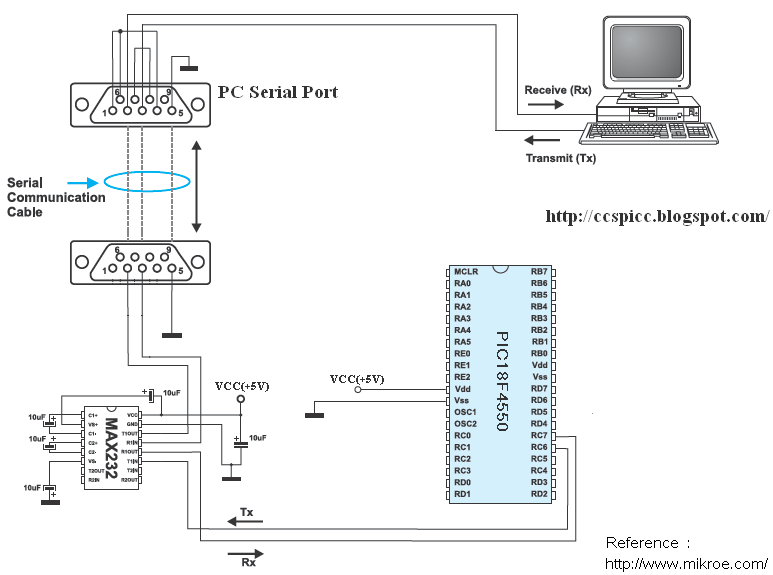
* This example uses FIFO RX and FIFO TX buffer to operate with the UART. You can set the size * for the FIFO buffers by modifying the RX_BUFFER_SIZE and TX_BUFFER_SIZE constants. UART Example for PIC16F887 CCS C code: The code used in this example is shown below. The function #use rs232(UART1, baud = 9600) is used to configure the UART protocol. Here the hardware UART module is used. If the pins TX and RX (RC6 and RC7) are used by an other application we can use software UART.
Chris: I have been testing some of the routines that you have provided. The UART routines that receive characters into the ring buffer and the receive interrupt work fine.
Where I am running into trouble is when I send characters via uart_putchar or uart_puts. It seems like the while loop that looks at IFG2 & UCA0TXIFX is where my problem seems to occur. It seems like it never waits there and characters overrun each other. Any ideas what could cause this behavior. I used your board initialization sequence as well. Thanks Mike O’Brien. Hey guys, thanks for the tutorials.
Wanted to let you know of an issue I had when using your Ring Buffer code. The ring buffer calculates the offset using a multiplication operation.
On the MSP430, the compiler pushes this operation into the MPY32 hardware multiplier. In my code I service the Ring Buffer in my ISR. Elsewhere in my code, I use the MPY32 to do other multiplies. I found a bug where if I was in the middle of calculating a multiplication and got interrupted by the UART, my multiplication would return a result of 0 every time. I was able to fix it by disabling interrupts before doing MY multiplication, then enabling them again once my multiplication was complete.
This might be helpful for others who try to use your ring buffer and have issues. Again, thanks! Hi Chris, Thanks for your reply. It seems as though it’s not really a bug in the compiler, your code is generating the mult. Here’s the line in question: const size_t offset = (_rb[rbd].head & (_rb[rbd].n_elem – 1)) * _rb[rbd].s_elem; This line generates a call to: __mspabi_mpyi. In MSP430s that have a HW Mult, if the –user_hw_mpy switch is enabled, it will call the MPY32 hardware multiplier.
The issue is s_elem is the size of the data in the ring buffer in number of bytes. If I limit this to be a base-2 size, I could replace the mult with a shift. Then data in the ring buffer could be 1, 2, 4, 8, 16 etc bytes. (My data is 1 byte, it’s a UART byte). My workaround is to just remove s_elem as an input to the struct, since it’s a constant for my application I can do this.
I don’t believe this is a problem with the compiler as much as it is a problem with the way the code has been written. An unintended consequence to writing portable and flexible code! Thanks for the clarification Russell. I think I see what you are referring to in the reference manual in section 11.2.5: “If an interrupt occurs after writing OP1, but before writing OP2, and the multiplier is used in servicing that interrupt, the original multiplier mode selection is lost and the results are unpredictable. To avoid this, disable interrupts before using the hardware multiplier or do not use the multiplier in interrupt service routines.” Did you try just disabling interrupts around that multiplication? I guess I kind of expected the compiler (or rather the libraries) to take care of this.
It seems somewhat strange to me that you can’t do a multiplication safely in different contexts without explicitly enabling and disabling interrupts. I suppose it may be because its too generic of a solution.
Nonetheless, I actually like your solution better. Since we have already made the caveat that the number of elements must be a power of 2, there is no reason why we can’t say the size of each element has to be a power of 2 as well so it can do bit shifting instead of multiplication. Am improvement for the future! And yes, writing portable code that always works on all devices, quite the challenge without introducing a ton of bloat 🙂. I have been looking for a more efficient way to buffer my UART data and came across this post. Awesome post and really efficient code! I think that you have a small typo (or else I may be missing something) in the section of the post where it says: “Typically, a wrapping operation is done using the modulus operation.
For example, the offset could be calculated like this: const size_t offset = (_rb[rbd].head & _rb[rbd].n_elem) * _rb[rbd].s_elem; ” I believe that the ampersand should actually be a modulo operator for that example, or else I am completely missing something! Haha Thanks again for the great post. Simply Embedded is a website dedicated to teaching and collaborating on embedded programming projects. All of the projects will be completely free and open source, as will the development tools used.
The first series is intended for those who have little experience with embedded software but have a decent understanding of the C programming language. It is a great resource for hobbyists, novice programmers, CS/EE students and hardware designers alike who could benefit from a better understanding of software. Principles of political science by a c kapoor ebookers uk. I encourage questions and discussions in the comments section and will be available to provide guidance along the way. The projects will be as real-world and practical as possible. The goal is to provide you with knowledge that is applicable to other projects and platforms.